Most Businesses Don't Have an AI Problem. They Have a Workflow Problem.

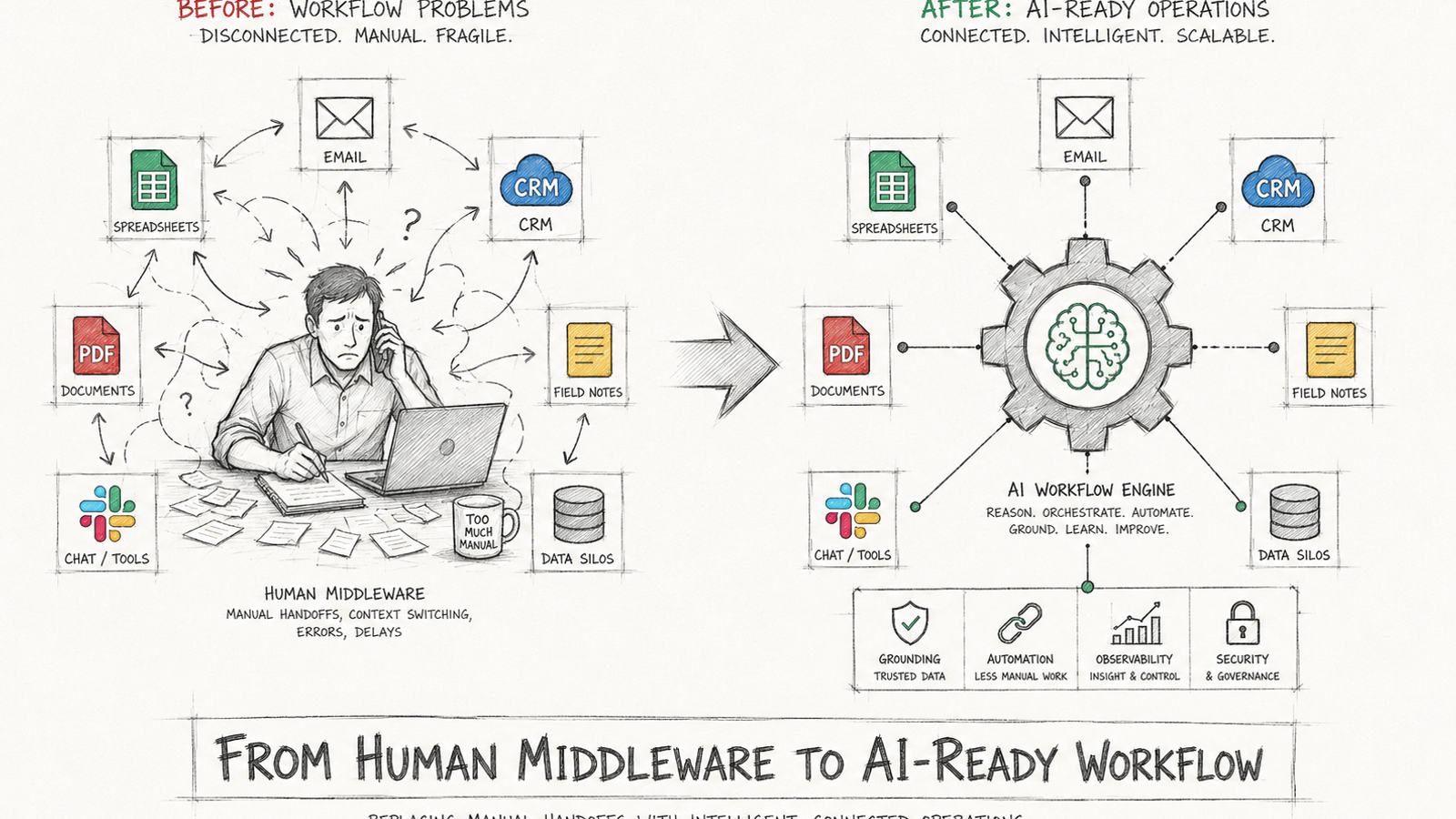
Author’s Note: This article is adapted from a presentation originally developed by my business partner, Morgan (of Philo Software), for the IBANNZ Workshop. When a sudden family bereavement meant Morgan was unable to attend, I stepped in on his behalf to deliver the session. As business partners in our SaaS product, OnSight, who frequently collaborate across Calo and Philo, these insights—especially the concept of "human middleware"—are born directly from our shared work in modernising technical workflows.
During the first wave of digital transformation, the conversation was almost always centered around a single question: “Which SaaS tool do you recommend we buy to fix this?”
Today, the vocabulary has changed, but the underlying instinct remains exactly the same. When people find out you work in tech, the question you get asked almost immediately, running a very close second only to “can you fix my printer?” is:
“What should our AI strategy be?”
It is a question that quickly spirals into a familiar list of tactical anxieties:
- Which AI platform should we actually use?
- How do we deploy AI across the business?
- Can AI replace this specific role?
These are reasonable, urgent questions, but they are being asked in the wrong order. Just as buying a subscription to a shiny new SaaS tool a decade ago rarely fixed a broken manual process, throwing AI at an unmapped business operation won't make it scale.
In my experience, most businesses don't actually have an AI problem. They have a workflow problem.
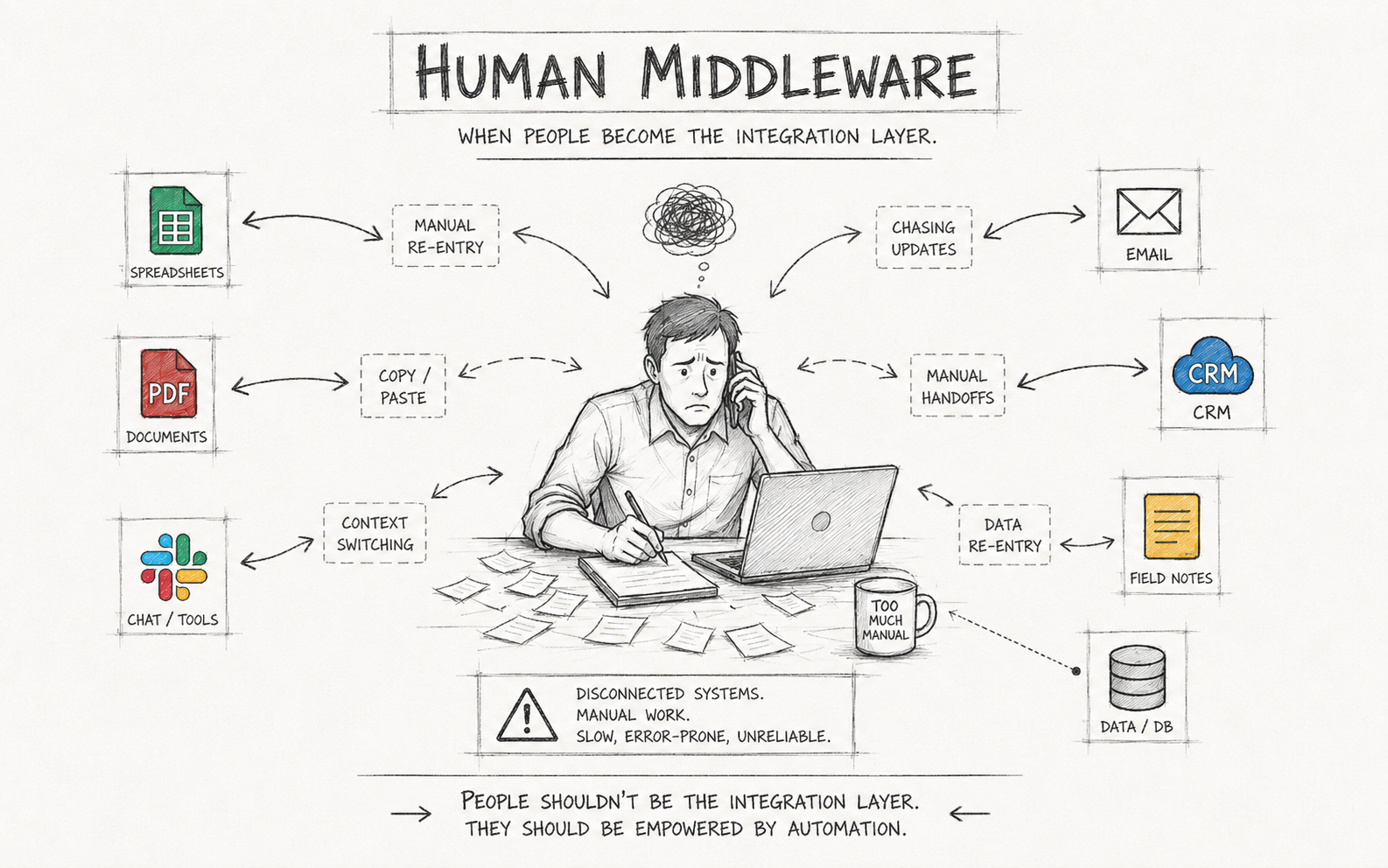
The Rise of "Human Middleware"
The irony of the SaaS boom is that while it successfully removed most paper from our offices, it often left us with a different problem: fragmented data.
One of the most common patterns we see in scaling businesses today is a concept coined by my business partner, Morgan: human middleware—a scenario where a person sits between two or more of these modern SaaS systems, manually moving, interpreting, or validating information from one place to another.
It typically manifests as:
- Copying data from one application into another.
- Updating spreadsheets from external reports.
- Chasing status updates by email or phone calls.
- Taking information from a field team and re-entering it into operational systems.
These activities have become so normalised that nobody questions them. Machines move data instantly, but humans don't. Humans have to read, interpret, re-type, and remember. While that works at a small scale, as a business grows, it becomes a hidden tax on operational efficiency. The result is an organisation that feels incredibly busy but struggles to scale without a linear explosion in headcount.
Why AI Often Disappoints
Many organisations hope AI will act as a magic wand to instantly vanish these challenges. Unfortunately, it doesn't work that way.
AI is an accelerator, not the engine. It amplifies what already exists. Well-designed processes become exponentially more efficient; poorly designed processes simply become more expensive.
If your information is scattered across disconnected silos, AI will struggle to provide reliable answers. If workflows are inconsistent, AI outcomes will be inconsistent. If your data quality is poor, AI will simply process that poor-quality data faster.
The New Playbook: AI as the Operational Glue
During the first wave of digital transformation, our playbook for solving these disjointed systems was straightforward: we would audit a business, find an off-the-shelf software tool to fill the gap, and if a tool didn't exist, we would roll up our sleeves and build custom software to bridge them together.
We wrote a lot of custom integration code just to get System A to talk to System B. It was time-consuming, expensive, and brittle.
Today, the underlying challenge is exactly the same, but the solution has radically shifted. We are building far less custom software because AI can now act as that operational glue.
Instead of writing thousands of lines of code to manually map data fields and handle edge cases, we can leverage AI's reasoning layer. AI can look at unstructured data in one system, understand the intent, translate it, and securely pass it to another. We aren't building giant new software suites anymore; we are building the intelligent connections between your existing ones.
The Core Shift: From the Programmatic Past to the Reasoning Future
To understand why workflows must come first, we have to look at how software has fundamentally changed. We have reached a Reasoning Inflection Point:
- Data Types: From Rigid Numbers to Unstructured Context
- The Programmatic Past: Systems were built strictly for numeric and relational data (dates, totals, stock levels).
- The Reasoning Future (2026): Systems now understand and synthesize unstructured, qualitative data (emails, call notes, feedback).
- System Logic: From Hardcoded Rules to Contextual Reasoning
- The Programmatic Past: Rigid, rules-based, and manual. Real-world human complexities had to be forced into predefined dropdowns.
- The Reasoning Future (2026): Flexible and multi-variable. AI uses contextual reasoning to progress data flows dynamically.
- Documentation: From Manual Entry to Self-Documenting Systems
- The Programmatic Past: Manual record-keeping, static forms, and time-consuming data entry.
- The Reasoning Future (2026): Self-Documenting. AI automatically maintains and updates records in real-time as work happens.
The Tech Under the Hood: Grounding AI in Reality
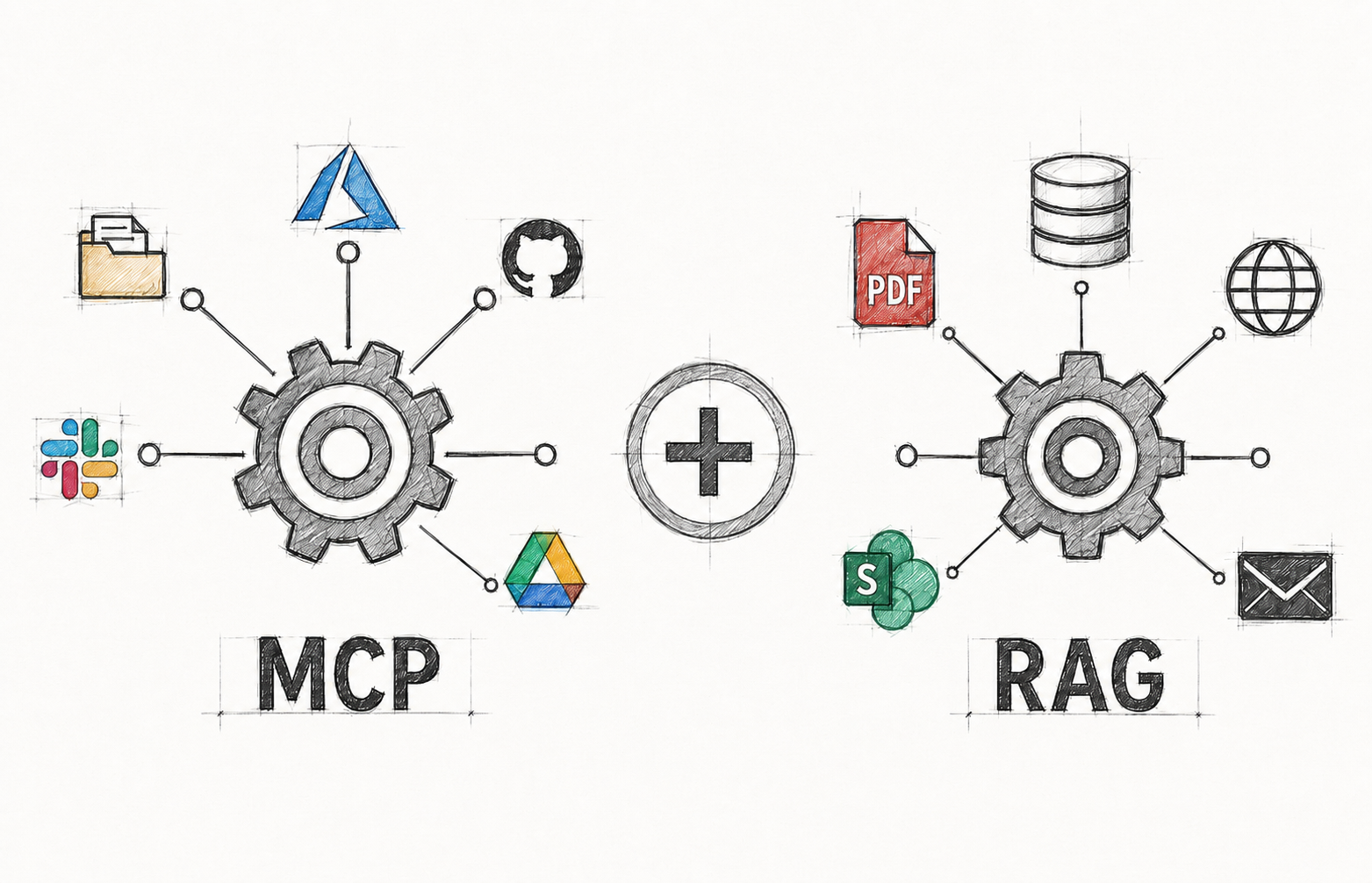
For AI to effectively eliminate human middleware, it cannot rely on generic knowledge or confident guesses. It must be securely married to your business’s live data. Today, this is achieved through two core frameworks:
1. RAG (Retrieval-Augmented Generation)
RAG bridges the gap between static AI models and your live business data. When an employee interacts with the system, the AI follows a three-step loop:
- Retrieve: It securely searches your internal knowledge base and connected systems for relevant documents.
- Augment: It combines that live context with the user's prompt.
- Generate: It produces an answer strictly grounded in your organisation’s facts, not probabilities.
2. MCP (Model Context Protocol)
If RAG is the architecture, MCP is the universal translator. Established as the industry standard, MCP is an open protocol that allows AI models to securely plug directly into your existing enterprise tools (like CRMs, ERPs, or Office 365).
If a software application doesn't support or plan to implement MCP, it remains an isolated data silo. Without it, you will always require human middleware to manually bridge the gap.
The Workflow Maturity Journey
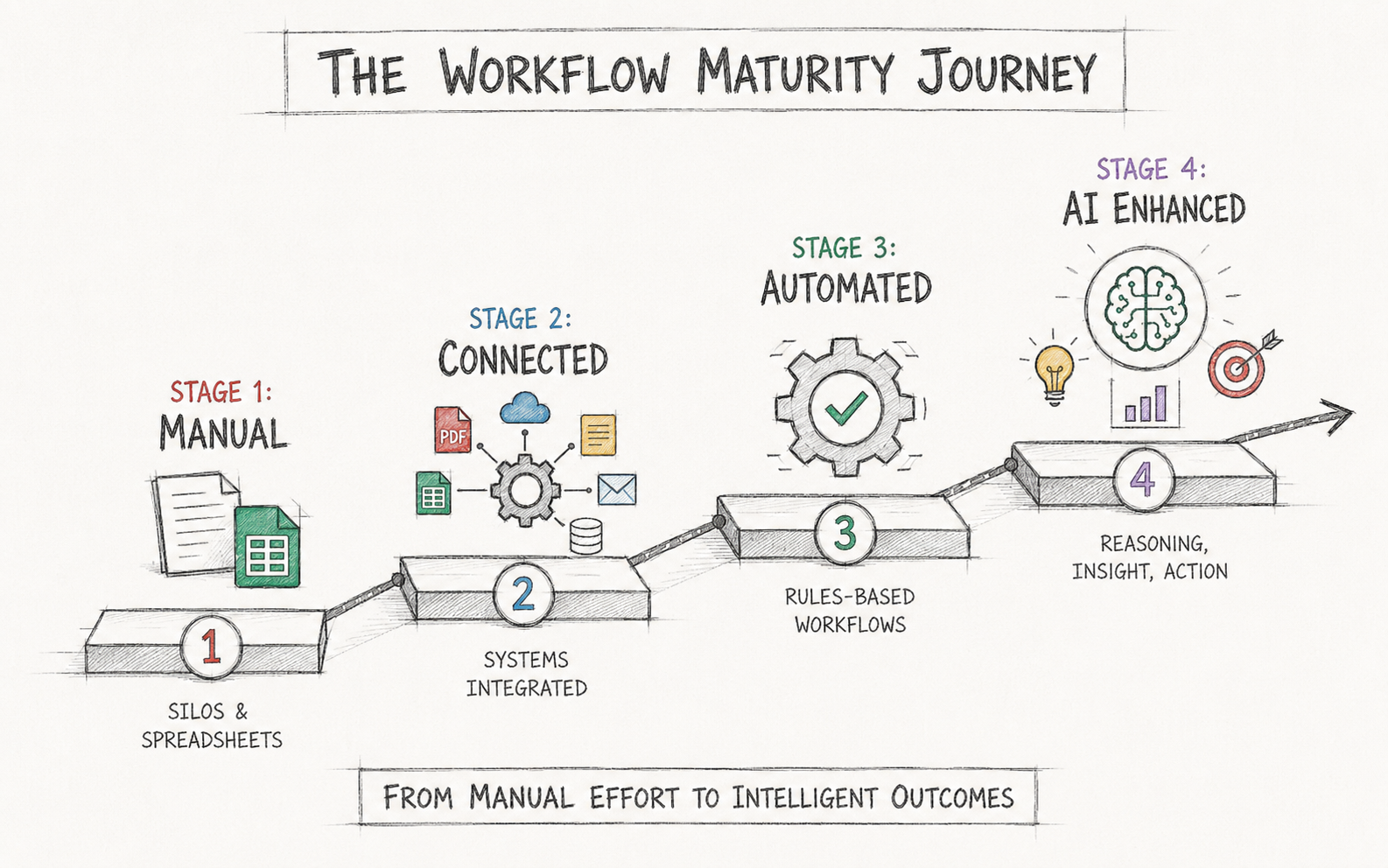
When we evaluate organisations at Calo, we generally see a distinct four-stage progression toward true AI readiness:
- Stage 1: Manual Processes – Information lives in disconnected silos, spreadsheets, emails, and individual heads.
- Stage 2: Connected Systems – Core systems are integrated. Data flows automatically between platforms, and manual data re-entry begins to disappear.
- Stage 3: Workflow Automation – Routine, rules-based tasks are automated. Teams spend less time administering the process and more time executing it.
- Stage 4: AI Enhancement – Grounded in reliable, connected data, AI unlocks its true potential: summarising context, generating real-time insights, making strategic recommendations, and executing workflows autonomously.
The Ultimate Dividend: Continuous Learning
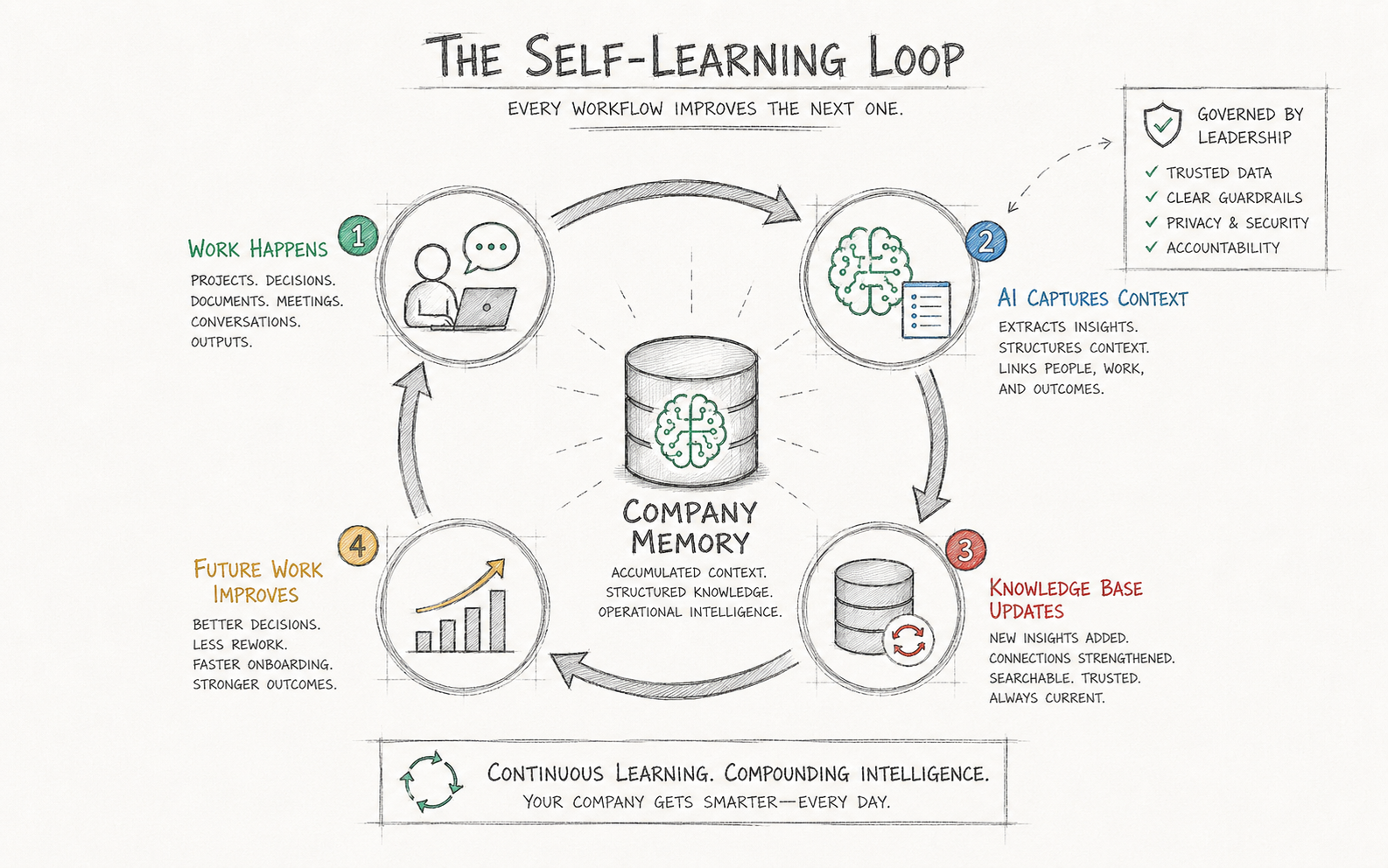
When you deploy AI on top of a mature workflow, you unlock a Self-Learning Loop. Traditional Standard Operating Procedures (SOPs) are static; they sit in a digital drawer and slowly drift out of date.
An AI-driven workflow captures live interactions, checks them against historical company memory, and continually pushes new operational insights back into the central knowledge base. Your leadership team stops managing repetitive data entry and shifts to a high-level governance role: analyzing the AI's analysis, refining the guardrails, and guiding system memory.
The financial return is compounding. By reducing manual "post-work" data entry by up to$80\%$, your business decouples revenue growth from linear headcount growth.
If your team is currently spending more time moving information than acting on it, the next step isn't buying another shiny AI tool. It’s auditing your workflows.
At Calo, we act as the pragmatic technical partner for business advisors and enterprise leaders. We break down data silos, remove human middleware, and build the high-velocity operational infrastructure required to make your business genuinely AI-ready. Let's collaborate to turn your strategic vision into functional reality.
Related Posts

You can't improve a process you haven't seen
